
Anthropocentric Ethics vs. Biocentric Ethics
October 30, 2026
In “What is Science-Based Wildlife Management?” (The Wildlife News, June 2026), I wrote that one way to understand this question is to compare unregulated game hunting of a century ago with contemporary game management that uses science to ensure sustained yields of hunted species. I went on to argue that it is more accurate to describe wildlife management as values-based rather than science-based because, although science may inform management decisions, values ultimately dictate decisions. This includes decisions about what scientific research to conduct.
If wildlife is managed primarily for human sport or trophy, it evinces an anthropocentric ethic, with wild animals valued primarily or exclusively as resources for humans. A biocentric ethic, by contrast, views wild animals as having value apart from human interests, with implications for how it is morally permissible to treat them.
This distinction between anthropocentric and biocentric ethics closely mirrors the A-B cleavage described by Aldo Leopold in “The Land Ethic.”

Burrowing owl, photo by Eric Trefney
THE LAND ETHIC
Leopold’s land ethic states: “A thing is right when it tends to preserve the integrity, stability, and beauty of the biotic community. It is wrong when it tends otherwise.”
Leaving beauty aside, integrity and stability are scientific concepts, while right and wrong in this context are ethical concepts, expressing what Leopold calls “value in the philosophical sense” — or what is commonly called intrinsic value. Leopold doesn’t try to prove the truth of the land ethic. In stating it, he in effect pronounces it true a priori.
Leopold further elaborates, saying, “The land ethic simply enlarges the boundaries of the community to include soils, waters, plants, and animals, or collectively: the land … [A] land ethic changes the role of Homo sapiens from conqueror of the land community to plain member and citizen of it. It implies respect for his fellow-members, and also respect for the community as such.”
These passages express an ecocentric ethic by attributing intrinsic value to the biotic community (land community) as a system, with a hint of biocentrism in the implication that individual members of the community deserve respect. But exactly what this is supposed to mean is far from clear. And as far as I know, he does not elaborate on it in any of his published writings. Respect and intrinsic value are not the same thing. For example, you might respect something simply for its role in an organization or community and want to preserve it for that reason, but this would not accord it moral standing, and the result would not be a biocentric ethic. In what follows I shall develop and extend the land ethic to include a biocentric ethic.

Red Wolf, photo by Eric Trefney
A MATTER OF MATTERING
If someone claims that something has intrinsic value — a wolf, for example, or a souvenir home run ball hit by Mickey Mantle — they are claiming that its value is not reducible to instrumental value or exchange value, and that it possesses value within itself.
Unfortunately, we have no criteria for verifying such assertions — no empirical test for determining if something has intrinsic value. On the other hand, if claiming that something has intrinsic value is just an expression of personal belief or sentiment, not a claim about reality, no one need share the opinion. Either way, the idea of intrinsic value isn’t much help for conservation beyond its use for expressing a sentiment or as a rallying cry.
I think we can do better. I propose that we go straight to the heart of the matter and ask what properties a thing must have in order for anything to matter to it. The idea is that if nothing that happens to an entity matters to it, then how we treat it doesn’t morally matter; or in the contrapositive, if what happens to an entity matters to it, how we treat it matters morally. We can say that to be such an entity is to have intrinsic value.
Consider a baseball. It doesn’t have a mind, isn’t conscious, doesn’t feel anything, has no memories or interest in the future, etc. It’s just a thing. When Mickey Mantle hit a ball out of Yankee Stadium, it felt no pain, nor did it achieve an aspiration. Nothing that happens to a baseball matters to it.
Still, bad things can happen to a baseball. A dog chewing on it, for example. But this is bad only because it becomes less valuable as a baseball or as a souvenir, which are purely human interests.

Dog with ball, photo by Tadeusz Lakota / Unsplash
What about a live tree? Cutting down a tree is obviously bad for it because it destroys its natural functioning. It can no longer grow or bear fruit. But does this matter to the tree? Does it feel hurt, betrayed, or prevented from doing something it wanted to do? Nothing I know about trees and other plants suggests that they care what happens to them. This isn’t to say that cutting down trees never matters, only that it doesn’t matter to them.
So, again, what properties must a thing have for something to matter to it? Particularly relevant to this question are sentience, intelligence, and consciousness.
Sentience. As I intend the concept, to be sentient is to have, at a minimum, the capacity for subjective experience, which is the capacity to perceive, feel, or experience sensations, such as pain, pleasure, warmth, and cold. It is not simply the capacity to respond mechanically to sensory stimuli, but to do so with accompanying feelings of repulsion or attraction. This would presumably require a nervous system of some kind.
Intelligence. To be intelligent, a creature must not only be sentient but must have the capacity to learn from experience. This involves 1) having perceptions that 2) represent features of its environment to a creature as valenced (things to go for, things to avoid), plus 3) emotion or feeling to motivate purposeful action, and 4) some form of locomotion to enable behaviors such as exploring, foraging, fleeing, mating, etc. For this, a mobile corporeal body equipped with sense organs and a nervous system is necessary. To be intelligent requires sentience and a lot more. It requires a “unity of consciousness — a self — with an integrated and complex life that recognizes its conscious events as “mine.”

Raven, photo by Tyler Quiring / Unsplash
THE RIGHT STUFF
So far as we know, trees, like baseballs, are not conscious, sentient, or intelligent. They do not have feelings or emotions, do not experience pain or pleasure, or joy, and do not learn from experience. They do not have eyes, ears, nervous systems, or brains. In short, they are not made of the right stuff to have the properties that give an entity moral standing. Although they have remarkable properties that are in some ways analogous to the properties of intelligent beings, how trees respond to their environments appears to be an entirely mechanical affair, like a reflex.
Or so I say. But in saying this, I am not claiming to know it, just that commonly known facts support it. These facts appear to be unexceptional and universal in our experience. I do not claim that it is perfectly all right to cut down trees. I am a tree-hugger. What I am claiming is that it makes sense to say that what happens to an intelligent animal, such as a coyote or a raven, matters to it; but not so for pine trees and palm trees or for plants generally.
Consciousness is essential to an intelligent being. Still, a skeptic might ask, “How can you know that trees are not conscious?” To which the rejoinder might be: “How can you know if a human being is conscious? After all, you can’t literally peer into another person’s mind.”

Palm trees, photo by Turtle Southern
The question and attempts to answer it are a result of misunderstanding the use of our language, and hence, misguided. They send our thinking in the wrong direction. The temptation is to think that we can’t really know what’s in the mind of another person because all we can observe are their actions and behavior, not the “inner” states and processes behind them. Presumably, we infer what goes on in a person’s private inner life by observing their outer behavior. But of course, in that case we could never know what goes on in the private experience of the mind of any creature whatever, or whether indeed there are any minds other than one’s own! This is known as the “problem of other minds.”
This conceptual dead-end has beset philosophy at least since Descartes. Three centuries later, the brilliant 20th-century philosopher Ludwig Wittgenstein astutely observed that it is not a question of knowing or not knowing what another is feeling or thinking, but of certainty. Doubting and knowing both require evidence, but radical Cartesian doubt excludes the very possibility of evidence by attempting to call an entire class of beliefs into doubt at once. Therefore, the use of “know” and “doubt” in this context is nonsense. Only in unusual circumstances can there be a real doubt about such matters — whether someone is lying or acting, for example, where the circumstances are unclear. As Wittgenstein noted in On Certainty, “If you tried to doubt everything you would not get as far as doubting anything. The game of doubting itself presupposes certainty.”

Mojave rattlesnake, photo by Patrick Alexander / Wikimedia Commons
The greater the difference between humans and other species of animal — Crotalus scutulatus, the Mojave rattlesnake, for example — the more difficult it is for us to empathize with them. This has to do with their bodies and behavior, but also with the degree to which their conscious life is psychologically rich and integrated across time, which may be far beyond our ken. Nonetheless, as the philosopher Thomas Nagel said in his famous article “What Is It Like to be a Bat,” bats, and by extension other animals, confront the world in subjectivity with minds that are peculiar to their natures. Charles Bowden captures “snaketime” in a wonderful essay in Wild Earth. In other words, Mojave rattlesnakes have conscious mental lives. Not very rich or integrated lives compared to those of birds and mammals, perhaps, but sufficient for their needs.
What about supercomputers and robots? Given the impressive advances in artificial intelligence, many people think that at some point supercomputers and robots might be conscious. (This brings to mind Stanley Kubrick’s 1968 film, 2001: A Space Odyssey, where HAL, the Heuristically programmed ALgorithmic computer that commands the spaceship, begs for its life while its memory banks are destroyed. Might this be an allegory for Elon Musk’s ambitions?) I do not share the speculation. Here’s why: Different kinds of atoms, molecules, compounds, substances, tissues, and organs all have unique properties. Common experience and scientific experiments show that the stuff a thing is made of invariably determines what properties it has. For example, hydrogen has specific properties and oxygen has specific properties, but only H2O has the properties of water. Copper is malleable and conducts electricity, while cellulose lacks these properties but has a high mechanical strength and is biodegradable. Neither is conscious or sentient, let alone intelligent. The obvious inference is that only biological organisms have these properties.
In spite of this, people are often deceived by appearances. It is easy to imagine a sophisticated humanoid robot being conscious, reasoning, having emotions, intentions, and the like. We can also imagine trees being conscious as portrayed in fairy tales, such as Hans Christian Andersen’s “The Fir Tree.” But to imagine something is not to conjure evidence for its existence or to show that it is possible, for example: non-existent things (unicorns) or logically impossible representations (M.C. Escher drawings). Computers and robots are no more conscious than a pile of beer cans. People who seriously imagine the presence of consciousness in trees, robots, rivers, or rocks, engage in pure fantasy.

Pronghorn, photo by Eric Trefney
CONCLUSION
What happens to intelligent creatures — animals — matters to them. This gives them moral standing, from which it follows that how we treat animals morally matters. This conclusion now becomes a premise in an argument that supports Leopold’s claim that the biotic community has value in the philosophical sense:
- The biotic community is a system of interdependent parts (members).
- The animal members of the community have moral standing, which is a kind of value that demands our respect.
- The other “members” of the community — soils, waters, plants, etc. — have contributory value because they are integral to the very existence of the animal members of the community.
- Consequently, due to the interdependence of the parts, including most especially the animals, and the systemic nature of the biotic community (what we might call its integrity and stability), the community as a whole has intrinsic value.
This biocentric ethic is supported by empirical facts, and it incorporates and expands upon the land ethic. However, a more complete and encompassing ethic requires further development to address the following questions:
- How does the fact that what matters to an animal give it moral standing? Peter Singer famously said it is the fact that they suffer. Of course, this cannot be the whole story. Consciousness is not limited to the experience of pain.
- Bobcats and ravens and rattlesnakes all have moral standing. Killing one for no good reason is therefore immoral. Human beings are members of the biotic community too and have moral standing as well; consequently, there will surely be times when we are justified in harming or killing another animal or destroying its habitat. Thus is the way of all life. Cases of self-preservation aside, when are such actions morally permissible? Do all species of animal have equal value from a moral point of view, or are there grades of moral value?
- A biocentric ethic implicitly assumes that human beings can behave ethically or unethically. For example, if lightning starts a forest fire and kills or injures thousands of animals, no immoral act has been committed, no ethic violated. But when an arsonist or a careless human causes the fire, it is another matter. Humans then, are moral agents, while other animals and natural phenomena such as lightning are not. Why is this? We do not regard a lion as morally defective when he kills. Is it because he does not intend to kill or does not regret it, as though he would if he could? No. Then what is it about human beings, but absent in other creatures, that endows us with moral agency? One suggestion is reason — categorical reason, as distinct from instrumental or hypothetical reason. This and the other questions will require a separate essay.
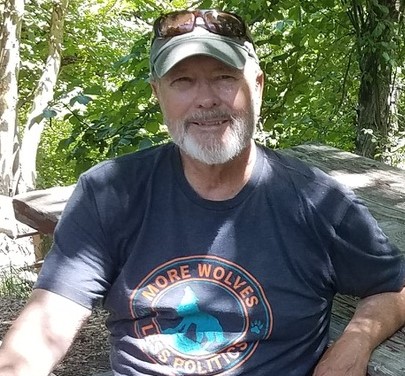
Kirk Robinson is the founder and executive director of the Western Wildlife Conservancy. He lives in Salt Lake City, Utah. Kirk has a Ph.D. in philosophy and previously taught courses at universities in Montana and Utah for 15 years.