
Intrinsic Value: Subjective or Objective?
October 29, 2026
I have always appreciated the Rewilding Institute’s commitment to “speak boldly for wildlife and land for their own sake.” However, expressions like “wild things for their own sake” mask a critical ambiguity. Do we mean that wild things have non-monetary, non-instrumental value to us — the way we might talk about, say, preserving historic buildings or cultural traditions “for their own sake” — or do we mean that wild things possess a moral significance that is completely independent of us?
I suspect that many readers will immediately answer the latter. It is important to note, however, that this is not how we employ the “for its own sake” locution in many other contexts. For another example, consider the well-known concept of “art for art’s sake” (“l’art pour l’art”). When we speak of art as being good in itself, we mean that art needs no justification in terms of its economic value, educational function, or other practical benefits. We don’t mean that artworks are moral subjects in themselves, or that art would have value even if there were no humans to value it. The same could be said about many other things that we might say are “good for their own sake,” such as knowledge, friendship, leisure, or spending time in nature.

Arrangement in Grey and Black No. 1 by James McNeill Whistler (public domain). Whistler was an influential proponent of “art for art’s sake” during the 19th century.
In an explainer for Nature, philosopher Ronald Sandler draws a distinction between what he calls subjective and objective intrinsic value. Subjective intrinsic value is “created by human valuing,” when something “is valued for what it is, rather than for what it can bring about.” Sandler offers the examples of “personal mementos, cultural and religious artifacts, ceremonies and rituals, accomplishments, performances, and historical sites.” As with art, we can value any of these things simply for what it is, not for any practical utility that it offers.
Sandler notes that “[m]any people value species and ecosystems intrinsically,” and thus species and ecosystems also possess subjective intrinsic value — but is that all?
Objective intrinsic value, in contrast, is “not humanly conferred” but exists “independent of anyone’s attitudes or judgments.” Sandler gives the example of the “value of persons.” The moral status of persons is fundamentally different from that of artworks, artifacts, or historical sites. We owe moral consideration to other people simply in virtue of their being people. We don’t owe any moral consideration to inanimate objects, irrespective of whether people value them intrinsically. If someone were to deface an object that has subjective intrinsic value, the moral harm would be done to the people who value it — not the object itself.

Most of Lyø’s ancient dolmens were disassembled for their material components, but the few remaining structures are now protected for their intrinsic value as historical artifacts. Neolithic dolmen on the island of Lyø, Denmark, photo by Kate McFarland
So how do we know if something has “objective intrinsic value”? In the case of persons, I posit that we can gain much mileage merely from self-reflection and the intuitive plausibility of the golden rule. We believe that other people owe moral consideration to us, and we understand that other people are basically constituted the same as us. It is an intuitive conception of fairness, then, that we “do unto others as we would have them do unto us.”
Crucially, this type of moral reasoning works because we recognize that other people have experiences and cognitive capacities that are similar to our own, despite differences in personalities and preferences. It is harder to know what it’s like to be a non-human animal, yet the golden rule still translates easily outside of the human domain. You don’t have to be a card-carrying PETA member to conclude that it’s wrong to kick a puppy because you can imagine how indignant you’d feel if someone kicked you, and you know that the puppy would also experience pain and fear as a result of being kicked.

Empathy for non-human animals can naturally arise from witnessing their complex cognitive and social lives. Crows engaging in play behavior, photo by Marie-Lan Taÿ Pamart / Wikimedia, CC BY 4.0
The question of what non-human animals experience as pain, pleasure, or well-being is a challenging one — but it is not empty. For this reason, I find it very plausible to ascribe “objective intrinsic value” to individual sentient animals, who have a perspective and at least some mental faculties. It is much less obvious, however, that we should apply the concept to species, ecosystems, or other collective entities, which cannot have conscious experiences of harm or flourishing. Sandler shares my skepticism, remarking (for example) that “it is not clear that there is anything that could be considered the species’ or ecosystem’s good above and beyond (or distinct from) the good of the individual organisms that comprise them.”
I have yet to find a compelling argument that nature has intrinsic value that is both objective and ecocentric, even though I have been tempted by such positions myself and explored the literature in some depth. Instead, I find the best attempts at ecocentric moral theory wind up providing more robust descriptions of what it means for a human to fully appreciate and revel in the wonder of nature. It is telling that the quintessential subject-dependent property of “beauty” appears in Aldo Leopold’s classic statement of the land ethic: “A thing is right when it tends to preserve the integrity, stability, and beauty of the biotic community.” This should not be taken to imply, however, that nature’s intrinsic value is merely in the eye of the beholder. Many philosophers, art critics, and laypeople alike believe that there are standards by which some artworks can be said to be “objectively” superior to others. Perhaps some aspects of nature’s value can be understood in an analogous way.

Nature benefits when people step away from a single-minded focus on instrumental value to spend time engaged in intrinsically valuable activities like forest bathing. Fredskoven, a forest near Rudkøbing, Denmark, photo by Kate McFarland
When discussing the intrinsic value of nature, conservationists and environmental philosophers often invoke concepts that are strikingly similar to aesthetic concepts: balance, stability, diversity, harmony, dynamism, and so on. The philosopher Robert Elliot famously developed another analogy to the art world in his provocatively titled article “Faking Nature,” in which he argued that ecological restorations are never as valuable as the original ecosystems that they aim to recreate, just as forgeries are never as valuable as original artworks. An observer of art might be said to lack discernment and sophistication if they regard every painting as no more than eye candy, with indifference to the artwork’s historical context, cultural significance, or even its more subtle aesthetic properties. On similar lines, we might suppose that anyone with sufficient experience and sensitivity should perceive wild nature as beautiful in virtue of the diversity of its biotic components, the harmony of their interactions, and the causal-historical chains that connect modern lifeforms to their deep-time evolutionary past.
Returning to our initial question, then, my own hunch is that it depends on what kind of “wild things” we’re talking about: Wild sentient animals, like humans, deserve moral consideration as individuals. On the other hand, it seems likely that biodiversity, species, ecosystems, and evolution are better said to have intrinsic value to us — more akin to art, knowledge, or culture.

Some people consider wildlife-friendly gardens “messy” compared to turf grass, but they protect ecological relationships that can themselves be described with aesthetic concepts like “harmonious,” “diverse,” “balanced,” “dynamic,” photo by OurMikeGeorge / Wikimedia, CC BY-SA 4.0
This distinction becomes critical when tension arises between different objectives, such as avoiding harm to individual animals versus protecting biodiversity or ecosystem integrity. When, if ever, are we morally justified in slaughtering invasive animals, using lethal control against predators to protect threatened prey species, culling animals to prevent overpopulation, translocating animals to establish new populations, or removing animals from the wild to confinement in captive breeding facilities, etc.?
In general, subjective intrinsic value is a much weaker moral consideration than the objective intrinsic value of individuals. Even when we believe that art, cultural traditions, and scientific research are intrinsically valuable pursuits, for example, we still accept ethical norms against practices that cause harm to persons, such as risky experimentation on non-consenting subjects. Many people also already accept that the welfare of some non-human animals carries greater moral importance than artistic expression, cultural heritage, or scientific curiosity. The intrinsic value of science does not excuse vivisection. The intrinsic value of culture does not justify bullfighting or ritual sacrifice like the Gadhimai Festival. The intrinsic value of art does not grant a license to controversial installations like Sun Yuan and Peng Yu’s “Dogs That Cannot Touch Each Other” (in which pit bulls faced one another on treadmills, charging to the point of exhaustion) or Marco Evaristti’s “And Now You Care” (in which piglets were to be left to starve in a shopping cart).

Preserving cultural traditions has intrinsic value, but it is often acknowledged that this value can be outweighed by considerations of animal welfare, photo by MarcusObal / Wikimedia, CC BY-SA 3.0
If the intrinsic value of biodiversity or ecological integrity is also subjective, then we should question whether it provides a strong enough moral reason to justify (for example) purges of non-native species of sentient creatures, such as the massacre of barred owls in the Pacific Northwest, which ethicist Bill Lynn condemned in an article for The Ecological Citizen.
This caveat might cause it to seem that I find little value in the concept of intrinsic value as applied to collective entities rather than individuals. In fact, I believe that it is imperative for us to defend the intrinsic value of species, biodiversity, ecosystems, and evolution, even if it is only subjective. When we do, we take a bold stance about how society ought to value things. Our defenses of nature’s intrinsic value strike back against an ethos of production and consumption that destroys not only wild nature but also the human soul (keeping us “working jobs we hate so we can buy shit we don’t need,” to quote Brad Pitt’s character in Fight Club).
Bertrand Russell lamented, “The modern man thinks that everything ought to be done for the sake of something else, and never for its own sake.” In this context, his spirited defenses of the intrinsic value of leisure and knowledge were both radical and necessary. It goes without saying that society’s materialism and narrow utilitarianism have scarcely improved in the 90-plus years since Russell penned “In Praise of Idleness.” Modern societies have chosen the blind pursuit of economic growth over greater leisure time to reflect on what is truly valuable for us — whether art, knowledge, interpersonal relationships, immersion in nature, or all of these — and wild nature may be the greatest victim. Subjective intrinsic value cannot serve as the entirety of conservation ethics, but neither is it a factor to be dismissed.
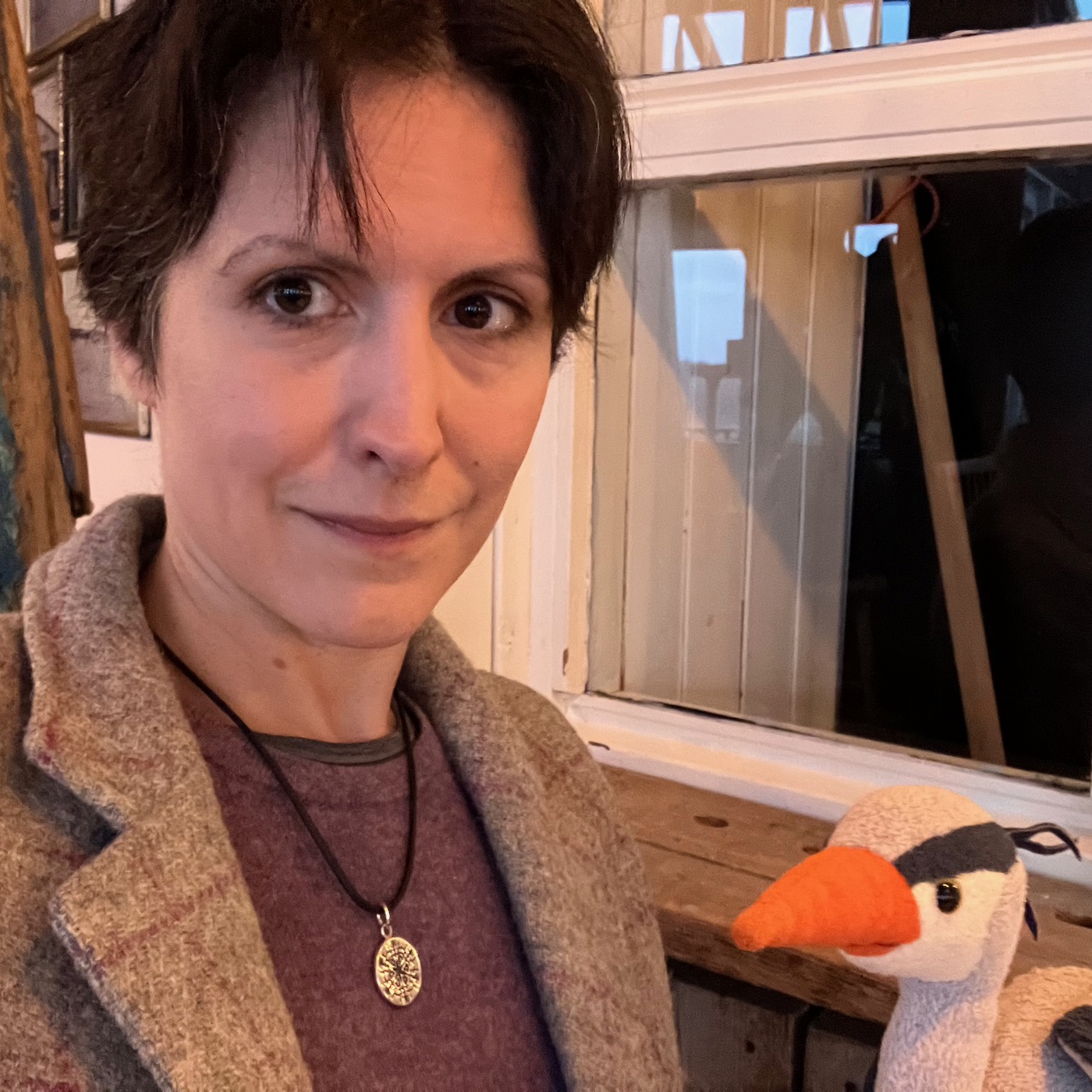
Kate McFarland is a former board member of The Rewilding Institute. Her rewilding-related interests subsequently settled on feathered fauna and flyway conservation, with accompanying interests in noise and light pollution mitigation, as well as non-anthropocentric conservation ethics.
