
Rewilding Human Consciousness
July 3, 2026

Jack Loeffler at home, photo by Katherine Loeffler
As I sat outside this morning, as I do every morning after I walk five laps to the other end of the block and back, I concentrated on my steady, relaxed breathing and slipped into the mode of consciousness I’ve been privileged to develop that aligns my very being with the flow of Nature endlessly passing everywhere on planet Earth at the same time. For me, this is where I begin to rewild my mind, a process that I practice every day. I freely admit some days are more successful than others.
For the past three years, I’ve lived in a community of about 20,000 fellow humans. Many, if not most, of the streets are lined with several species of deciduous and evergreen trees that separate the houses. On my moderately busy street, automobiles, pickup trucks, bicyclists, runners, walkers, dogs, and mule deer abide in modest abundance. During the warmer months, twice daily the skies are aswarm with turkey vultures, while ravens dance playfully, and crows collectively cry out in behalf of their territorial imperative and chase away infrequent raptors — although the occasional peregrine falcon chases after them. Canada geese honk their presence as they fly near the jewel of a river that flows through this community. Magpies abound throughout the year, as do the Eurasian ring-necked doves who have supplanted other dove species. Robins flit about, their chirps rendering their mellifluous song of good cheer (or so is my interpretation). The mountain chickadees frequently land in a bush near my head, and their tiny but strong cheeping evokes my empathy. The downy woodpeckers, red-shafted flickers, and Lewis’s woodpeckers often visit and avail themselves of food found in the bark of tall trees lightly tended by the human community. Presently, seven mule deer are passing through my yard. Just as these deer are urbanized, I conversely ever attempt to rewild my own consciousness.

Carracas Mesa near Cedar Rock, photo by Patrick Alexander / Wikimedia Commons
In 1965, when I was 29 years old, I applied for a position as a fire lookout in the Jicarilla Ranger District of the Carson National Forest in northwestern New Mexico. At the time, it was regarded as the most primitive fire lookout within lands administered by the National Forest Service, a division of the U.S. Department of Agriculture. There was no lookout tower, no structure, just a two-acre formation of Navajo sandstone that rises above the surrounding forest of ponderosa pine with areas of piñon-juniper grassland at lower elevations along the sides of Carracas Mesa. I landed the job, and as near as I could tell, the Cedar Rock lookout was somewhat above 7,000 feet elevation. For the first year, I would park my pickup truck with a camper at the base of “the Rock,” as it was colloquially known. In the following years, I was able to jockey my truck to the top of the Rock, where I would sit in the cab and log lightning strikes during thunderstorms, thus assuring myself that I wouldn’t be targeted by virtue of the insulation provided by four air-filled tires and the metal-covered chassis.
It was while on the fire lookout that I became part of the wildlife. For three seasons, I camped atop the Rock for 100 days and nights a year. I was surrounded by the breadth of the forest. The wildlife gradually accepted me: The calls of wild turkeys and coyotes frequently charged the air, the distant scream of a mountain lion occasionally invigorated my nighttime imagination, the sight of seven wild horses running side by side…

Coyote, photo by Larry Lamsa / Wikimedia Commons
An ancient trail, known as the Old Spanish Trail, passes through the forest. During an earlier century, Hispano traders drove sheep and carted buffalo hides to Los Angeles to trade for horses, some of whom escaped into the wildlands surrounding the Rock on the traders’ return to Santa Fe and environs. My consciousness gradually began to run wild as I disassociated from the prevailing commons of human consciousness, itself fraught with distraction by the burgeoning fruits of the Industrial Age.
It would be three or four more years before I would read Garrett Hardin’s provocative essay, “The Tragedy of the Commons,” and 19 years before I would actually sit down with Dr. Hardin and discuss the relevance of the ‘commons’ as well as his account of “An Ecolate View of the Human Predicament,” the name of his essay published in an autumnal 1984 edition of Scientific American. He was wheelchair-bound as the result of having contracted the dread polio during childhood. I liked him as a fellow human, and thereafter would occasionally visit, bringing gifts of fresh fruit to him and Mrs. Hardin that we would consume in their backyard in Goleta, California, and simply shoot the breeze.

Hopi tradionals and Jack testifying against coal mine on Black Mesa, 1972, photo by Camilla Smith
It was in 1967 while purchasing a 40-acre inholding in the Jicarilla Ranger District where I was a fire lookout, that I learned certain powers that be (a major gas company and the federal government) intended to detonate a subterranean atomic bomb to create a heated-sealed cavern to contain natural gas for future commercial use. Subterranean natural gas deposits characterize the greater San Juan Basin region. This was scheduled to occur on the south boundary of the Jicarilla Ranger District. Thus, I became involved in my first environmental fight. None of those ‘powers that be’ had extrapolated that the gas would be radioactive and thus rendered unusable by humans. Such was indeed the case after the A-bomb was detonated. Those ‘powers that be’ had yet again violated Nature’s principles by misapplying science in the name of progress in an endless attempt to turn natural habitat into money. And power.
I spent my last season as a fire lookout on the Rock in 1968. That year, I sadly registered that my view to the west, which had previously provided a clear view of the Chuska Mountains, was becoming hazy. Why? Because the Four Corners coal-fired electrical generating station that had gone online near Shiprock in 1963 had belched enough noxiousness into the atmosphere to cloud the land of clear light, the hallmark of the North American Southwest. It was also the same year that my naiveté about protecting the forest from wildfire for the sake of the trees was forever purged. I had realized that the trees of my Paradise were to be selectively sold to timber companies by the U.S. Forest Service, and that soon, even the land itself would be threatened with intent from the ‘powers that be’ by fracking for drilling of natural gas wells. And oil. And whatever else could be mined and sold, thus ever-depriving Place of its Spirit.

Black Mesa Defense Fund original gang with Four Corners Power Plant in background, photo by Terrence Moore
I left my fire lookout for the last time the day after I put out the fire of a lightning-struck tree. Still, I was optimistic. I had been offered a position to curate a traveling exhibition to visit as many Bureau of Indian Affairs schools on the Navajo Reservation as possible. The exhibition presented an account of Navajo history from the cultural perspective of the Diné, the Navajo People who were otherwise being forcibly educated into the ways of the White Man’s World. That project lasted deep into 1969, whereafter I donned a backpack filled nearly to the brim with a battery-operated stereo tape recorder and necessary accoutrements, and wandered into the Sierra Madre Occidental of western Mexico to record music of the Tarahumara Indians (Rarámuri) in the Barranca del Cobre. I then wended my way to the village of San Andrés Coimiata in the Río Chapalagana watershed, homeland of the Huichol Indians (Wixárika), the peyoteros whose beautiful culture inspired me to live my life as I have these last 57 years.
As best I could adapt, I have been partly re-shaped by Indigenous Mindedness. I had previously lived with traditional Navajos at Navajo Mountain for half a year. I had met and become acquainted with Native Americans from several different cultures in earlier years. A Hopi elder and I had become and remained friends. The Tarahumaras were among the toughest fellow humans I ever encountered because of their lifestyle, which included strengthening their extraordinary endurance by running up and down the steep slopes of Barranca del Cobre.
I lived with the Huicholes, recorded their music, witnessed their peyote-induced re-enactment of their creation myth, and simply relaxed into their culture whose language was far removed from my own. One day while hiking along a trail between villages, I met a lone Huichol man dressed in his beautifully hand-crafted embroidered garments; he was so deeply involved in his peyote vision that he regarded me as an hallucination. These experiences transformed my perspective and led to the epiphany that the Native cultures of the North American continent, and likely elsewhere, had been shaped in great measure by the habitats where they dwelled for generations. Where habitats remained intact, and fellow humans lived in balance with Nature. This was a great realization that took me some time to intellectually define, even to myself.
Thus, I began to practice re-naturing my consciousness. In other words: rewilding my mind.

Dave Brower and Jack Loeffler looking at a coal stripmine, 1972, photo by Tom Pew
I became deeply involved in environmental activism. I developed a profound friendship with Ed Abbey, a man who also loved and needed wilderness for spiritual restoration after bouts of contending with life in the world of monoculture. For two decades until he died, we were compañeros. Three or four times a year, we bid adieu to our wives and wandered forth to remote corners of the Southwest for up to two weeks at a time. This was long enough to re-immerse ourselves in the wild and long enough for me to regain some sense of that state of consciousness I’d attained when camped atop the Rock earlier on. It was this state of mind that Ed and I shared and realized was essential for deep sanity. This Nature-attuned state of mind was and remains endangered today, like an endangered creature whose habitat is pillaged by errant humans for whom this state of mind is either lost, or never existed.
I gradually came to realize that major habitats, many species, AND Indigenous Mindedness are all endangered. Yet they are vital to the health of our planetary biotic community. We humans are the dominant species and have enormous responsibility to blend reciprocally with this biotic community to ensure its health. We have squandered aspects of our self-discipline in paltry pursuits of money and attendant power. During my lifetime, now less than 100 days shy of 90 years, the human population of our planet Earth has grown from 2.2 billion to 8.3 billion —almost 400 percent in less than a century — less than a long human lifetime.

Photo by Jack Loeffler
I hark back to my conversations with Garrett Hardin that addressed common pasture lands, and in subsequent conversations with friends whose minds were/are wide-ranging and finely honed. I have come to see water as a commons, air as a commons, land as a commons, planet Earth as a commons. And I now go beyond that in my realization that human consciousness is itself a commons — a commons often seduced by the fruits of techno-fantasy and greed, a commons still capable of intuition and great beauty, and a commons in profound need of rewilding.
I have met and often befriended hundreds of fellow humans of many cultural persuasions, and almost everyone has shown herself or himself to be kind and sharing. In my opinion, it is the system of cultural attitudes dictated by governing bodies caught in the sway of the prevailing corporate paradigm, ever-forwarding growth for the sake of growth, that has led our species astray. Unless we re-Nature our minds, re-wild our consciousness, and generously reciprocate with our biotic community, we face extinction.

Jack Loeffler and Jim Hopper from Black Mesa Defense Fund on the San Juan River, 1971, photo by Terrence Moore
Thus, I sit outside each morning recalling earlier years when I backpacked, hiked endlessly, ran rivers, stared into thousands of campfires, and vigorously pursued the practice of defending our Earth. I deeply reflect on my kindred-ness with every life form that has yet existed on planet Earth these last four billion or so years since the miracle of LUCA, our Last Universal Common Ancestor. LUCA was a single living cell that possibly emerged into existence near a hydrothermal vent in an ancient sea, a cell from whom all life on planet Earth is descended, with whom all lifeforms share genetic code. I meditate and relax into a deeper level of consciousness that is in harmony with Nature and finds compassion for every life form. I practice a slow breathing exercise with my eyes open while focusing my visual attention on nearby foliage, and open my intuition to my kindred-ness with all life.
Each day, as best I can, I go skinny-dipping in the flow of Nature and am restored. I forever attempt to rewild my own consciousness, then share that wildness within the commons of human consciousness. To me, our planet Earth, warmed by the Sun, is a sacred place and a miracle of life and cognition — our home adrift in space.
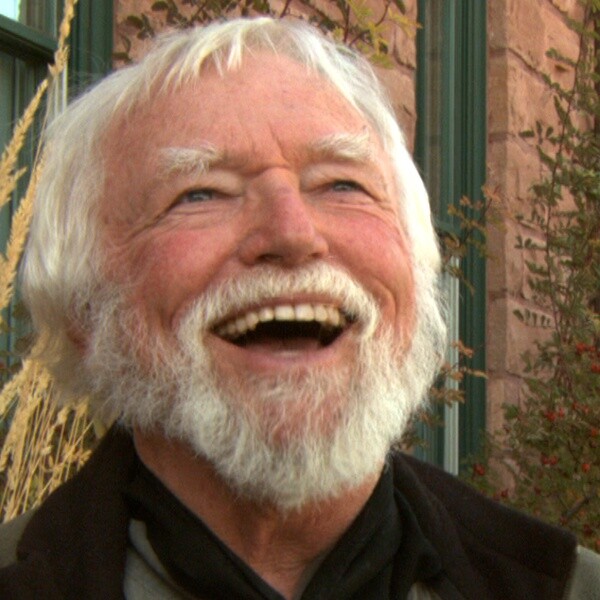
Jack Loeffler is an aural historian, environmentalist, writer, radio producer, and sound-collage artist. He is the author or editor of many books, including Headed Into the Wind: A Memoir, Thinking Like a Watershed: Voices from the West, Survival Along the Continental Divide: An Anthology of Interviews, Adventures with Ed: A Portrait of Abbey, and A Pagan Polemic: Reflections on Nature, Consciousness and Anarchism.
Check out the Rewilding Earth Podcast interview with Jack here: “Episode 63: Jack Loeffler on Rewilding Human Consciousness and Tales From An Extraordinary Life.”