
Rewilding All Five Kingdoms
October 28, 2025

Lupine by Kenyon Fields
We should consider all five kingdoms of life in our rewilding work. While with good reason, rewilding proponents have focused largely on apex predators and other keystone species, we should remember that these evocative creatures are necessary but not sufficient to thriving ecosystems. The Five Kingdoms taxonomy of life was best outlined by Lynn Margulis and Karlene Schwartz in their landmark book of that name two decades ago:
Bacteria | Protists | Plants | Fungi | Animals
Realistically, most of us hominids are unlikely to think of bacteria or protists in our work (even though we mammals are largely comprised of them), and unnaturally, human civilization—which tends to eliminate large rivals—may be favoring many members of these two ancient kingdoms over most members of the more complex lifeforms. So perhaps we can fairly focus on rewilding plants, fungi, and animals.

Bug on Dryas integrifolia by Kenyon Fields
Such thoughts have gone through my mind on recent outings. On a hike of western Maine’s Grafton Loop in the spring, Northeast Wilderness Trust’s Executive Director Jon Leibowitz and I could guess about ecological health more from plants than from animals. We saw many birds and a few squirrels, but the heavily browsed mid-story spruce and fir trees told us that if wolves are not allowed to recover in Maine soon, moose may browse accessible parts of this forest to the ground. As Jon noted, wilderness and rewilding are about freedom, yet in this region rewilding processes have not yet brought back apex carnivores, so the plant communities seemed fettered by unnaturally high concentrations of herbivores.
Then in June, in Alaska’s Noatak National Preserve, I was on a trip with several members of the Rewilding Leadership Council to spread more of Dave Foreman and Nancy Morton’s ashes in their favorite wild places. Eerily hot weather kept the charismatic megafauna scarce, but, since spring had been wet, it allowed an Arctic bloom that rivaled wildflower displays anywhere. The winsome little heaths and roses and other green wildeors are as essential as the bears and wolves and caribou we craved to see—and some of them may be as vulnerable to anthropogenic climate chaos.

Caribou trails in scree rock and moss by Kenyon Fields
During six photosynthetic weekends this spring and summer, Jerry Jenkins and his Northern Forest Atlas Project team enraptured 20 students and several volunteer assistants (including me as designated Roustabout!) with teachings on finely distinguished plants, particularly mosses, sedges, and grasses. The detailed look at such species that most people lump together underscored what Michael Soulé and Reed Noss prescribed a quarter century ago in their paper for Wild Earth, “Rewilding and Biodiversity: Complementary Goals for Continental Conservation:” Protect big wild cores connected by broad wildways (rewilding) but also protect representative samples of all habitat types (biodiversity) lest rare or specialized species fall through the cracks of our reserve systems. Of course, if we protect big enough areas, we can include most rare communities and species in big, wild cores. That is a happy but likely distant future; meanwhile, let’s heed the needs of every region’s enigmatic microflora as well as its charismatic megafauna.

Reasons for including plants (and fungi) in our rewilding work, then, include these:
- Plants are inherently beautiful and meritorious.
- Plants maintain the biosphere and provide the infrastructure that affords life bountiful opportunities for complexity and diversity.
- Plants tell us how well their predators, aka herbivores, are doing, and in turn how the apex predators that eat those herbivores are doing, making plants apt focal species for rewilding plans.
- Plants have great admirers among humans who might not otherwise care much about wild Nature.

Shotting star by Kenyon Fields
Some plants are foundational or focal species. Hemlocks, for instance, are often critical for providing year-round shade to streams that otherwise might be too warm for trout and salmon. American chestnut was a foundation species—providing rich food, especially nuts, to myriad creatures—until blight (caused by a fungus brought to the United States by people) decimated the tree. Some plants and associated insects, as well as some narrow-niche micro-fauna, depend on special habitats that could escape our notice if we focus exclusively on apex predators and other keystone species.
Paul Ehrlich, Gerardo Ceballos, and Rodolfo Dirzo remind us in their book Before They Vanish: Saving Nature’s Populations—and Ourselves that the extinction crisis is not yet so much about the complete loss of species as it is about the loss of populations, and thus of ecological function and genetic diversity. Rewilding proponents often strategically focus on wild cores and keystone species, but let’s also work alongside naturalists who love plants and fungi and the noble members of all five kingdoms.
—John Davis, wildways scout, writing from Adirondack Park, fall 2025
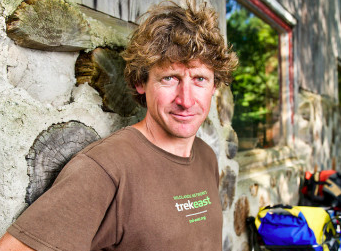
John Davis serves as wildways scout, editor, interviewer, and writer for the Rewilding Institute. He also works as a rewilding advocate for the Adirondack Council, a member-supported group defending the ecological integrity and wild character of New York’s great Adirondack Park. John serves on the boards of RESTORE: The North Woods, Eddy Foundation, and Algonquin to Adirondack Conservation Collaborative. He previously was editor of Wild Earth and worked for the Foundation for Deep Ecology. In 2011, John completed TrekEast, a 7,600-mile muscle-powered exploration of wilder parts of the eastern U.S. and southeastern Canada. In 2013, he trekked from Sonora, Mexico, north along the Spine of the Continent as far as southern British Columbia, Canada, ground-truthing Rewilding North America and promoting habitat connections, big wild cores, and apex predators.