
Sense of the Wild: Three Poems on Nature, Loss, and Legacy
August 5, 2025

Sense: Poems by Lawrence E. Stevens. Published by the Author, 2025. ISBN 979-8-8959-0259-2.
Editor’s Note: In this post, three select poems are shared from Larry Stevens’ new poetry anthology, Sense.
Improbable Cause (Kim Crumbo, 1947-2021)
It was inevitable that water would take you, for all the oceans you dived, the rivers you ran, those dark-of-midnight missions, the swiftwater rescues you led. And only our remarkable luck that you stayed among us long enough to find and voice your irrefutable optimism for protection of wild nature.

They found your canoe and brother’s body on the windy shore of that Yellowstone lake, but not your body. In the ensuing search the pilot reported seeing a wolf swimming across the lake, your baptismal transformation and rewilding complete.

“There is good in this world, and it’s worth fighting for,” you said. But with your passing I am left with a hole in my being the size of the Yellowstone caldera. I walk now in a world of ghosts and giants, filled with memories of roaring rapids, great bravery, and music at night by riverside, half-drunk on beer and all loving.

Alone now, without solace on this equinox, obsolete as some cambarid decapod, left-justified and frustrated by loss, constrained like a therizinosaur with its impractical claws, howling in proto-lupine outrage at elected frauds, ratting out the monied fiends in high places, who smilingly hack away at the wild you love. Better throw the bastards down those slippery Kalalau cliffs you worked so hard to save, into seas so monstrously large they slash-erode away flat what remains of this No Man’s post-cyclopian paradise.

The water ouzle bursts forth madicolous from behind a waterfall, sings its skritchy, lilting hymn to the springbrookriversea, the wolves and whales, knowing like Crumbo, our dear friend, our hero, our savior lost, the words and deeper meaning of life, love, wilderness, and Louie Louie.
Songs of the Humpback Chub
We come from that muddy river, funny looking and nearly blind,
Colorado River Gila cypha, Sipapuvani2 of the humpback kind,
We survived the ice age floods and the droughts when the river was low,
But the trouble really started when the Bureau built the dam those many years ago.

Glen Canyon Dam turned the Colorado River from a warm muddy raging stream,
To a regulated river with daily fluctuations and a trophy trout fisherman's dream.
But the changes haven't been all bad for us fish with the Colorado cold and clear,
And we love those shrimp-like scuds as much as boatmen love their beer.

    Bring back the river, set that muddy water free,
    We want to frolic and spawn our whole lives long
    In the shade under Whaler's boat,
    In the sky blue waters at the mouth of the Little C.

Now we're caught between the lies of the river compact and the lawyers of the CRSP3,
Selling our natural heritage for hydropower subsidy.
The only way the barons of water and power in the Colorado Basin states
Want to see us is filleted on a sesame bun with tartar sauce on their plates.

But we've got friends in the government to help us out of this mess,
They study us with radio implants, stomach pumps and trammel nets.
As the fishery biologists fight over their portions of the research funding dish,
The Arizona Game and Fish Department has done everything that you can think of to a funny-
       shaped fish.

    Bring back the river,
    We'd beg you on our knees (but we don't have knees)
    Don't walk all over our muddy water home,
    Set the Colorado free.

For all the money spent studying us, we could use a couple extra grand,
We want to buy us a humpback time-share condo aquarium in Disneyland.
Bony and the Rounder have a hot scam going on a worm ranch east of Grants,
And Lucy wants the money to try out one of those silicon hump implants.4

To all our friends on the water and the rim above river mile sixty-one,
We wish you all a long, full life and a happy spawning run,
But we are fish out of water, and now it's time to go,
And the songs of the humpback chub are brought to you
Straight from the heart of the wild Grand Canyon,
Live from a river called the Colorado.

    Bring back the river,
    Set that muddy water free
    We need floods, warm water, and adaptive management,
    Or set the Colorado free.

    Bring back the river, set that muddy water free,
    We want to frolic and spawn our whole lives long
    In the shade under Whaler's boat,
    In the sky blue waters at the mouth of the Little C.

    Set the Colorado free,
    Set that muddy water free,
    Set the Colorado free.

1 This poem was used as the lyrics for a song under the same name. It is archived in the Smithsonian Folkways Collection, and has been released on UTube at (https://www.youtube.com/watch?v=ihvhO_2lCyU).

2 “Sipapuvani” refers to the Hopi place of emergence, a travertine dome spring in the Little Colorado River (LCR) several miles upstream from its confluence with the mainstream.

3 “CRSP” refers to the Colorado River Storage Project Act (1956), which authorized the Upper Colorado River Basin states of Colorado, New Mexico, Utah, and Wyoming to develop coordinated water delivery required by the Colorado River Compact (1922), and resulted in the construction of Glen Canyon Dam.

4 “Bony”, “Rounder”, and “Lucy” are shorthand names for bony-tailed chub (Gila elegans), round-tailed chub (Gila robusta), and Colorado pikeminnow (Ptychocheilus lucius), respectively, species now lost from the Colorado River in Grand Canyon.
Merit
(Nothing in (life) makes sense except in the light of evolution.
T. Dobzhansky, 1973)

You realize, of course,
    that had your primal proto-bacterial ancestor been consumed
    before undergoing binary fission four billion ago,

Or had your tetrapod ghost fallen in Late Devonian, Permo-Triassic,
   or many other extinctions,
Or had that single parasite not embedded itself
   in your proto-mother’s pre-mammalian placenta,
Or had your rabbit-rodent ancestor not escaped
   that one particularly vicious Eocene nimravid,
Or had your pre-hominin father failed to protect the troupe
   from that pack of Pachycrocuta hyaenids,
Or had your great to the umpteenth Viking grandfather
   refused to sail for William against England,
Or had your great-great grandfather
   died of tetanus in that Rebel prison,
Or had your parents never met in Montreal
   and started their life together,

You would not be here to read this simple reminder,
    you would never have had the chance
To break your heart, cry through “Just Walk Away Renee”,
    to love your daughter more than yourself,
To feel the sun and rain on your face,
    and sense violet hour on the mountain.

You realize, of course,
    your entire existence is the result of extraordinarily stupid dumb good luck,
    with only the very slimmest, most miniscule sliver of merit.
Where to Get the Book
Sense is available from the author, who donates all proceeds to the Springs Stewardship Institute (SpringsStewardshipInstitute.org) to improve scientific understanding and management of springs. Springs are among the most biologically and socio-culturally diverse and productive ecosystems. Springs are highly ecologically interactive ecosystems that support not only richly diverse biotic assemblages internally, but also contribute enormously to the integrity of the surrounding, extrinsic landscapes. Unfortunately, due to a long history of being ignored by governance, the public, and the scientific and conservation communities, many of the approximately 20 million springs on Earth are ecologically impaired or have been dewatered and lost. To improve springs’ stewardship means implementing an “archipelago” conservation strategy, one that in Aldo Leopold’s words, “saves the pieces” to enhance springs’ intrinsic and contextual ecological integrity. SSI is working vigorously to bring springs conservation to the forefront of conservation attention because “what’s good for springs is good for all things.”
To find out more about SSI, visit our website at springstewardshipinstitute.org and check out our new book, Springs of the World: Distribution, Ecology, and Conservation Status.
To request a copy of Sense, contact Larry Stevens, P.O. Box 1315, Flagstaff, AZ 86002 USA. Cost in USA + shipping: $30.
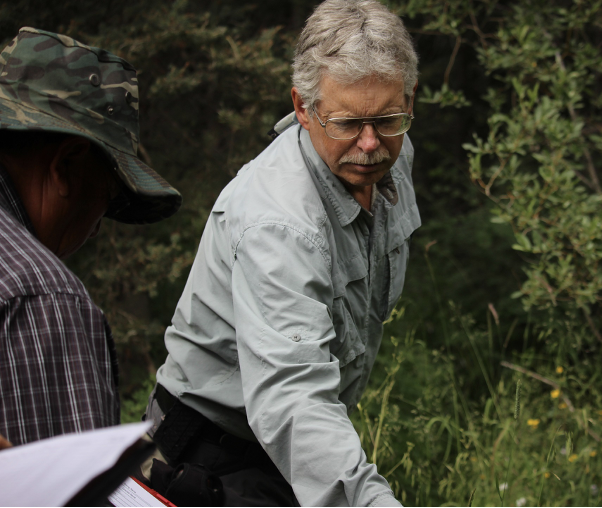
Larry Stevens was born in Cleveland, Ohio and moved to Arizona in 1970 where he attended Prescott College from 1970-1974. After working as an NPS biological technician and a river guide, he undertook graduate studies in fine arts and biology at the University of Arizona. He received his Masters degree in Biology in 1985 and his doctoral degree in Zoology in 1989, both from Northern Arizona University. He served as ecologist for Grand Canyon National Park from 1989-1994, and as the editor of Red Lake Books until 2006. He teaches occasionally at both Prescott College and Northern Arizona University and has served on more than 40 senior, master’s, and doctoral student committees. He continues to work as a whitewater rafting guide in the Grand Canyon. He is presently the director of the 501(c)3 Springs Stewardship Institute in Flagstaff, and is the principal investigator for Stevens Ecological Consulting LLC, and serves as the honorary curator of ecology at the Museum of Northern Arizona. He is the senior ecologist for Wild Arizona-Grand Canyon Wildlands Council, in which position he has served as a conservation representative for the adaptive management of Glen Canyon Dam and the Colorado River through Grand Canyon since 2004. In those positions, he brings to bear more than 50 years of scientific research on springs and aquatic ecosystem ecology, land and water resource management, aquatic and riparian species biology, and advisement to all levels of governance, several Tribes, and many NGOs and scientific colleagues. Larry has authored more than 150 scientific and popular publications, including books on river running in Grand Canyon, the ecology of spring and stream ecosystems, global biogeography, dragonfly ecology, and conservation. He recently compiled an anthology of poems written throughout his life, entitled Sense (2025).