
Wild on Purpose: The American Prairie Story and the Art of Thinking Bigger
February 16, 2026

Book review of Wild on Purpose: The American Prairie Story and the Art of Thinking Bigger by Sean Gerrity, Torrey House Press, 2025
Rewilding requires big thinking, and this book is the story of people, especially the author Sean Gerrity, who dared to think big and take risks with remarkable results. Today, American Prairie is a private nonprofit project that is protecting and rewilding 3.2 million acres of northern plains in the conservative state of Montana, “the largest wildlife reserve ever established in the Lower 48 states,” as Ken Burns writes of it in his Foreword. Part memoir, part description and history of the American Prairie project, and part helpful suggestions based on his experience leading the project for 17 years on how to do big things, Wild on Purpose is a compelling and easy read that leaves me more hopeful about rewilding than I had been for a while, especially amid what is happening in environmental politics in the Trump era.
American Prairie is a private, non-governmental initiative, and word needs to spread about it in this time of government retrenchment — perhaps destruction is a more apt term — of environmental protection in the U.S. Gerrity explains that there are only four places on Earth where, according to scientists, there exist “room and appropriate conditions to restore large-scale, fully functioning grassland ecosystems, and the Northern Great Plains is one of them.” This being the case, and with human depopulation occurring, farsighted conservationists were considering the idea of creating a vast private conservation project to rewild a portion of the Northern Great Plains. Since the U.S. government stopped establishing large-scale parks and reserves across the country over recent decades and since much of the Northern Great Plains were privately owned, non-governmental initiatives needed to come up with expansive thinking about new possibilities.

Gerrity recounts how Dr. Curt Freese, a conservation biologist with the World Wildlife Fund, shared with him the idea of building a big, new wildlife reserve in the Northern Plains and restoring and rewilding it. “As I listened to his vision of what would one day become American Prairie, he explained that moving today’s baseline back in the direction of what used to be would require reassembling the native habitat and creating conditions that allow for all native species to return to spectacular abundance.” Freese explained that achieving such a vision would require participation of the local community, part of which would certainly oppose such an idea, and Indigenous Tribes who would likely support such an effort. A reserve and rewilding project on the scale Freese described would be an ecology project with lots of political, economic, and sociological challenges.
A perceptive outdoorsman who had seen and been concerned about threats to the natural world and biodiversity, but not an active conservationist, Gerrity was intrigued by the visionary project that Freese described. Searching for new directions in his professional life, Gerrity thought participating in such a project might open a path for him, though leading such a big effort in a new field did not seem a likely prospect as he listened to Freese — but he changed his mind.

Gerrity hooks the reader in Wild on Purpose with a tense “Prelude” in which he describes transporting the first eight frightened bison to American Prairie in bad weather, on slippery roads, from Wind Cave National Park in South Dakota to American Prairie in Montana. Conditions for the trip were awful, and getting stuck would likely be the end of the bison and the project, but they made it. Right away, the reader finds Garrity an engaging writer, then an optimistic one who calls himself a “possibilist” versus a blind optimist. He writes, “In a world where the baselines have shifted to the point where conditions in the natural world are sorely out of balance — and our own collective imaginations have diminished so much — somebody has to think big about these things.”

But before he explained how he landed this job, Gerrity told his personal story, revealing the many experiences that prepared him to take on leadership of a massive conservation project in the face of many doubters. The gist of his background is that he became a highly successful entrepreneur, building a consulting company working with start-ups and training business managers on leadership and teamwork, but after 16 years, he was ready for new challenges. Eventually, with no experience in conservation leadership but deep personal knowledge of what he wanted out of the next stage of his career, Gerrity was convinced by Freese and others to join them and transfer skills and knowledge he brought from the business world to a new start-up — the American Prairie Reserve, which became American Prairie. They convinced Gerrity he could learn what he needed to know to build a conservation organization while they brought the scientific expertise necessary for rewilding land that the organization would acquire.

How does one go from beginning such a project with limited resources to achieving such an audacious goal as a three-million-acre reserve linked to public lands around it, adding up to some five million acres that might allow rewilding of species like American bison, kit fox, prairie dogs, wolves, grizzly bears, bighorn sheep, and other fauna and flora? How does someone from outside of professional conservation work become successful in leading a major conservation project? Gerrity admits to taking a great leap into the unknown.
He tells lots of stories along the way — how he learned the art of fundraising, of recruiting and working with a board of directors, of dealing with skeptics and outright opponents, and engaging the community, including Indigenous Tribes. There were setbacks, and he made mistakes, but the trend line was upward as American Prairie raised lots of financial support, purchased land, and launched into rewilding.

Wild on Purpose is full of ideas about how to launch and build an organization, with examples from his experience. One challenge he and most conservationists face is fierce opposition, in the American Prairie case from many in the ranching community who consider the idea of a wildlife reserve as a threat to their way of life. Gerrity cites business writer Michael Hammer’s 20-60-20 model, which posits that 20 percent of affected people will embrace a proposed change, 60 percent will ponder the pros and cons of the change, and 20 percent will adamantly oppose it. The focus, therefore, must be on the 60 percent who might be persuaded to support the change. This may be obvious, but such an insight was very helpful to him in understanding the responses received from the community affected by the proposed reserve and in setting his priorities in interacting with them.

Another striking idea is what Gerrity calls the “Montana Triangle,” explaining that he understood American Prairie to be part of a concept of “holistic core areas connected by corridors approach that ensures robust and genetically diverse species populations into the future.” A graphic shows three nodes of such core areas: the Northern Continental Divide Ecosystem around and including Glacier National Park, the Greater Yellowstone Ecosystem, and the Northern Great Plains Ecosystem. Influenced by his conservation biologist colleagues, he learned how American Prairie might be part of such a large-scale approach to protecting biological diversity in Montana, where much has been accomplished but with continuing challenges, as Trump tries to dismantle the federal portion of the Montana Triangle.
Gerrity tells the American Prairie story in a personal way, sharing his growth and what he learned as he faced many challenges, and how he transferred ideas from his business experience to conservation work. He shares in considerable detail how he tackled challenges. There is no doubt in this reader’s mind that he hopes others will follow his path into nature conservation, helped by his experience and insights.

At the end of Wild on Purpose, he cites theologian and author Matthew Fox who has written about what is needed to “craft a continuously improving society:”
“Fox theorizes that perhaps the single most helpful thing might be to work together on preserving nature on a large scale. He reasons that in order to do so, everyone involved would have to try to understand nature at a deep level. This means learning about interdependencies within and between complex systems, appreciating the ever-changing, dynamic aspects of those systems. It means being willing to be persistent, open-minded, and prepared to change our own long-held assumptions to help in the long-term solutions required to protect nature. By doing all of that, he theorizes, we would learn the generic fundamentals and mindset required to effectively make myriad other societal improvements as well. I think Fox is right. I’ve found that working on land conservation issues that will benefit wildlife and people pushes us to operate out of our best selves, to think much further into the future than other topics might demand of us, and to stay true to our goals while accommodating others’ motivations as well.”

Since I’m writing this for Rewilding Earth, I know what the late, great Dave Foreman would think of Gerrity and American Prairie. Foreman’s focus was on public lands, and he was skeptical that the private sector would or could do what was needed to embrace meaningful rewilding. The scale would have to be so big that only the government could do it. Toward the end of his life, Foreman was discouraged. Like Gerrity, he was a “possibilist,” but the possibilities for rewilding seemed to him to be receding.
Foreman’s and Gerrity’s careers could hardly have been more different, but as I read Wild on Purpose, I couldn’t help but think of Foreman’s plenary speech at the Wilderness Fifty Conference in 2014. In that speech, and in Gerrity’s book, the message about what needs doing to preserve nature and the values and rewards for doing that work are the same. And both of these experienced, powerful leaders urge others to follow their example. Foreman was delighted by what American Prairie had achieved in his lifetime, and if he could read this book, he would be encouraged by Gerrity’s “possibilist” views of what can and likely will be done to preserve nature.

Gerrity writes, “Given the trends I am watching [which he briefly describes] and the people with whom I am privileged to speak and who are part of driving those trends, I honestly believe the long-term looks promising for my pre-school-aged grandchildren. I really do believe that, when they are middle-aged adults, they will see and experience much cleaner air … far more small and large parks and protected areas having been dedicated as wildlife sanctuaries, better protected wildlife populations in the oceans and terrestrial places, and less pollution overall than existed way back in 2025.”

Foreman would be raging at what the Trump administration did to environmental protection in 2025 and at what this president will continue to do until he is gone. He would have questions about Gerrity’s possibilist optimism, but would congratulate him and his colleagues and thank them for doing some of what he prescribed in his landmark book, Rewilding North America.
Gerrity’s message is timely. Big things are still possible in conservation, but time is short to act before rewilding becomes ever more difficult. The work of conserving nature has never been easy, but possibilities abound. The current storm must be weathered. Confidence that the work can be done must be sustained. American Prairie, and this book about it, is an inspiring story that is an antidote to pessimism and discouragement in these challenging times.

Get your copy of Wild on Purpose here. All photos by Dennis Lingohr, except top landscape and sage grouse courtesy American Prairie. Map courtesy Sean Gerrity.
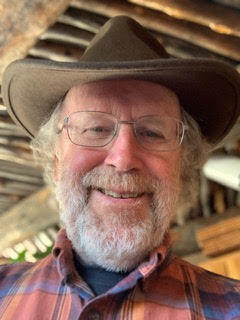
David Brower, then Executive Director of the Sierra Club, gave a talk at Dartmouth College in 1965 on the threat of dams to Grand Canyon National Park. John, a New Hampshire native who had not yet been to the American West, was flabbergasted. “What Can I do?” he asked. Brower handed him a Sierra Club membership application, and he was hooked, his first big conservation issue being establishment of North Cascades National Park.
After grad school at the University of Oregon, John landed in Bellingham, Washington, a month before the park was created. At Western Washington University he was in on the founding of Huxley College of Environmental Studies, teaching environmental education, history, ethics and literature, ultimately serving as dean of the College.
He taught at Huxley for 44 years, climbing and hiking all over the West, especially in the North Cascades, for research and recreation. Author and editor of several books, including Wilderness in National Parks, John served on the board of the National Parks Conservation Association, the Washington Forest Practices Board, and helped found and build the North Cascades Institute.
Retired and now living near Taos, New Mexico, he continues to work for national parks, wilderness, and rewilding the earth.