
Learning from Tracked Birds: Conservation and Compassion
February 27, 2026
A recent post in Rewilding Earth, “Rewilded Condors Find a Haven in Chilean Patagonia,” discusses the importance of satellite tracking for the protection of Andean condors. Condors equipped with transmitters reveal that they spend less than a quarter of their time within protected areas, necessitating a broader approach to conservation.
This is one of many examples of the way in which birds equipped with wearable tracking devices, such as satellite and radio transmitters, can help humans make better informed conservation decisions. In 2021, satellite-tagged seabirds led researchers to discover a previously unknown biodiversity hotspot in the North Atlantic, about the size of France. The North Atlantic Current and Evlanov Seamount was subsequently granted status as a Marine Protected Area.

Spoonbill family in Vlieland, Netherlands (Photo by Kate McFarland)
Some of the most important revelations have involved critical stopover sites that migratory birds use to refuel during their journeys. Satellite tracking of endangered great knots and critically endangered spoon-billed sandpipers, for example, uncovered important sites in China’s Yellow Sea region. Such research was instrumental in the Chinese government’s decision to ban the reclamation of coastal land for development. More recently, the first tracking studies of Dalmatian pelicans showed that these critically endangered birds lack stopover habitat in Mongolia, prompting the Mongolian government to begin conservation action. In a recent success story from the U.S., tagged red knots revealed significant stopover sites in South Carolina — a discovery that led the state government to restrict the harvesting of horseshoe crabs (red knots’ favorite food) during migration periods.

Red knot juveniles in flight, Argyll, Scotland. (Photo by Sharp Photography)
I recently argued in Rewilding Earth that our concept of habitat connectivity for migrating species should extend to airspace — reducing the hazards of obstructions from built structures like power lines and wind turbines to sensory pollutants like artificial light. Here, too, tracking studies provide valuable insight. GPS tracking data have been used to map areas where birds are especially vulnerable to collision with power lines or turbines and monitoring birds’ avoidance responses to offshore wind farms. A recent story from the International Crane Foundation described how the organization incorporates satellite transmitter data in studying the spatial requirements of whooping cranes, information that it uses to promote responsible siting of new energy infrastructure. On the topic of light pollution, GPS tracking has been used to study the size of “dark refuges” needed to protect fledgling seabirds from becoming grounded.

Cory’s shearwater fledgling in Tenerife, Canary Islands — grounded due to light pollution. (Photo by Airam Rodríguez)
These are only some of the many examples of the conservation value of tracking studies. Let me now turn to one side effect of such research: Learning the stories of individual birds encourages us to empathize with their struggles and triumphs as unique sentient beings. From a rewilding standpoint, this is arguably its most radical implication.
When I became interested in environmental ethics, I wanted to give shape to the intuition that moral value in nature encompasses more than the well-being of individual creatures. Through armchair thought experiments, I tried to pinpoint this additional source of value, moving from biodiversity to the integrity of ecosystems and finally to the natural unfolding of ecological and evolutionary processes. It was a philosopher’s game, but it bled into my thinking about conservation. Like many, I used to scoff at concern for animal well-being as anti-ecological.

Whooping cranes at their summer territory in Adams County, WI. (Photo by Ted Thousand, International Crane Foundation)
For me, birds brought back home the undeniable moral importance of the suffering of individual creatures. When I gathered the lifeless bodies of songbirds as a Lights Out collision monitor, I didn’t think about the ecological roles that those birds would no longer play, only about the tragically premature loss of life. Those tiny migrants each had their own story, their own path, their own destination that they would never reach. Likewise, when I read stories about migratory birds equipped with transmitters — or follow birds “live” on Global Flyway Network, Movebank, or the Motus Database — the conservation of species is an afterthought. I root for those particular birds to overcome the myriad obstacles on their journeys.
When I was first becoming involved in bird conservation, one story that moved me was that of Siberian Crane 419. Before he was tagged, 419 had been found near China’s Liao River, ill from ingesting poisoned bait, one leg deformed due to a waterfowl trap. When he was released back into the wild (sporting a satellite transmitter), he struggled to fly. Eventually, however, 419 recovered to migrate and find a mate.

Siberian crane (Photo by Brandon Zhang)
More recently, I devoured the story of Sinagote, the protagonist of the eponymous book published in four languages. Named for her Breton wintering ground, Sinagote was (is?) a Eurasian spoonbill born on the Dutch island Vlieland in 2006 and tracked since 2013. Vlieland happened to be the island that made me an irredeemable spoonbill fan, so I felt a bit of a personal connection, which was deepened through the intimate telling of her life and ways. Sinagote went “off grid” in 2022 and was last sighted in the Netherlands in the same year. It is hard not to share rangers’ fears about obstacles along her typical journey, such as the IJsselmeer wind farm.
Bird-safe design — of sheet glass or wind turbines, for example — is an animal rights issue. We need building standards to reduce fatal hazards for other sentient beings just as we need standards to protect human lives from conflagrations or structural collapses. We should design to prevent fatal window collisions for birds like Evening Grosbeak 228 and minimize the risk of wind farms to birds like Sinagote — simply because that’s the consideration we owe to other creatures who share our environments.

Eurasian spoonbill flying with satellite transmitter on back (Photo by Kate McFarland)
As humans, we love a good story with a charismatic protagonist on an epic journey. Is this just a psychological bias that gets in the way of science-guided conservation? I submit, on the contrary, that becoming engrossed in the lives and stories of individual birds and other wild creatures is exactly what we should do. We should conceptualize them as individual intelligent agents, because that’s precisely what they are. Moral attention to the well-being of individual animals does create serious dilemmas for conservation, but to ignore it would be its own type of human chauvinism.
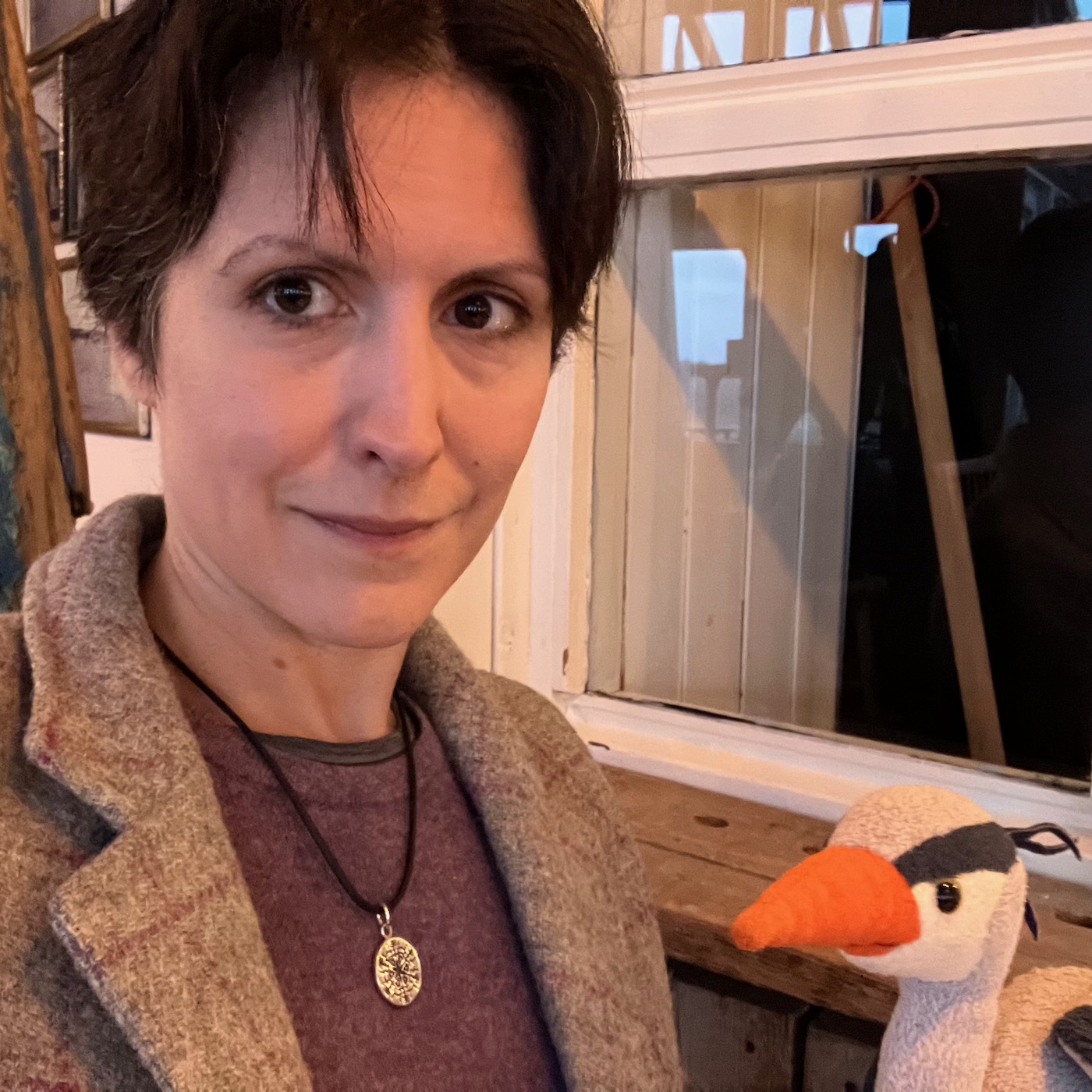
Kate McFarland is a former board member of The Rewilding Institute. Her rewilding-related interests subsequently settled on feathered fauna and flyway conservation, with accompanying interests in noise and light pollution mitigation, as well as non-anthropocentric conservation ethics.